

Shiny Hurting People, Imaginary Umbrellas, and Biblical Authority: Bill Gothard and IBLP

It was the summer of ’73, a hot and miserable evening in the San Bernardino Fairgrounds, when I stood from a steel folding chair and placed myself firmly under my umbrella of protection. My entire family had gone to hear the man of the moment, Bill Gothard, at his Institute in Basic Youth Conflicts (IBYC), a week-long seminar for all ages. Young, ignorant, and powerfully zealous, I had no clue that Gothard’s principles would gut my initiative, twist my understanding of the Bible, warp my view of God, or hamstring my future marriage. 

And yet that is exactly what they did.

Continue reading “Shiny Hurting People, Imaginary Umbrellas, and Biblical Authority: Bill Gothard and IBLP”
Awkward! Why I Don’t Look for Ways to be Led by Every Man I Meet.

I’ve been interviewing painters. These days it seems so difficult to find someone who will do any work for a decent price – I mean someone who will do good work for a fair price. But we need the house painted, so I’ve been talking to a few men who claim they know how to wield a brush. The bids have been all over the map – anywhere from sky-high to lunar-high. Until the last guy, who we hired.

After our lucky painter left, I was thinking about something I read in a recent book arguing for distinct roles for men and women in the church. More of a practical how-to than a detailed biblical defense, I imagine that even if I agreed with the premise, numerous ideas would give me pause. One, in particular, came to mind after the departure of our competent and reasonable painter.

Continue reading “Awkward! Why I Don’t Look for Ways to be Led by Every Man I Meet.”

According to Complementarian Michael Kruger, Listening to Women is Essential if We Hope to Successfully Confront Spiritual Abuse in the Church

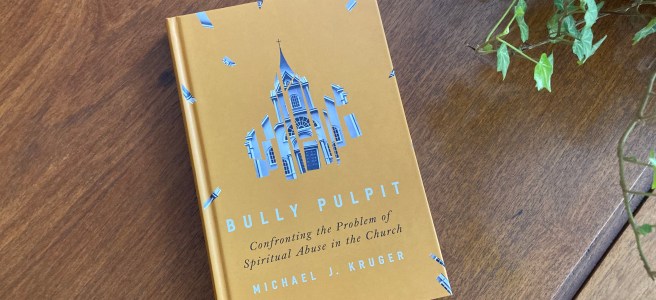
Christianity Today ran a nice review of Michael J. Kruger’s new book Bully Pulpit: Confronting the Problem of Spiritual Abuse in the Church. I wholeheartedly agree that Kruger’s book is small yet mighty and will prove invaluable in addressing the issue of spiritual leaders who, as Kruger states, use their position to manipulate, domineer, bully, and intimidate those under them in order to maintain their power and control (24). 

However, the complementarian reviewer failed to mention the place Kruger grants women in identifying and confronting abuse by religious leaders. In his extensive research, Kruger spoke with people in different denominations and with varying theological viewpoints from across the country. These included pastors, leaders, congregants, and victims themselves.

What Kruger learned was this: women’s voices are essential, yet too often dismissed. Continue reading “According to Complementarian Michael Kruger, Listening to Women is Essential if We Hope to Successfully Confront Spiritual Abuse in the Church”

They Should Have Known: Jephthah, Southern Baptists, and Sacrificing the Vulnerable

Early this year I started penning an article on Jephthah, but I had so much going on that I found it difficult to quiet my mind for writing. Things have settled down a bit now, though, so here goes nothing.

You may recall the narrative. Jephthah was that incomprehensible character who so misunderstood God’s word and his ways that he sacrificed his daughter to fulfill a vow. It’s one of those Bible horror stories that I hate so much, yet somehow feel compelled to decipher. Even when I try, I can’t escape my inner need to comprehend what went wrong and what we can do to avoid falling into the same trap.

Continue reading “They Should Have Known: Jephthah, Southern Baptists, and Sacrificing the Vulnerable”

Why I Write: For the First Time, Women Are Less Religious Than Men

I haven’t been posting much on my blog lately, partly because I’ve been working on some other writing projects but also because I’ve taken a position at my church as the executive pastor. But recently Christianity Today came out with a report that explains why I write, why I believe God has called me to throw my hat in the ring with so many others who are discussing what the Bible does and does not say about women.

“With Gen Z, Women Are No Longer More Religious than Men” details recent research demonstrating that the differing rates of religious involvement for men and women in the United States, which previously has always shown higher rates among women, has reversed in younger generations. It is no surprise that compared to previous generations there are more nones (who identify as atheist, agnostic, or nothing in particular) among all Gen Zers (women and men). The startling fact is that this is the first generation in which women nones outnumber men.

Continue reading “Why I Write: For the First Time, Women Are Less Religious Than Men”

Does Authority Matter?

There’s a lot of talk about authority in Christian circles these days – who has it, who does not, who should, who should not. For some it has become a dividing line between truth and error, solid ground and slippery slope, particularly when it comes to who holds authority in the church and in the home. 

More than anything, conceptions of authority govern who speaks and who is silent, who leads and who follows, who decides and who agrees. In extreme cases, authority grants one Christian the right to tell another she must not leave her violent husband. In more run-of-the-mill scenarios, authority justifies affixing “unbiblical” to a marriage where responsibility, decision-making, and initiative are shared, where the hopes and dreams of both are equally cherished. 

On both sides of the deck beliefs about who has authority, how authority functions, and who may sit in official positions of authority define the limits of the pool.

Continue reading “Does Authority Matter?”

Can a Woman Be a Pastor’s Right-Hand Man?

Just to clarify, I’m not talking about the pastor’s Girl Friday, who pens the letter in his name, buys the coffee at Costco, and types the announcements into the bulletin. Neither am I referring to the pastor’s Yes Man, the one who is uniformly loyal, gets behind every plan, and takes the pastor’s side in every disagreement. 

What I’m thinking of is that person who can be fiercely loyal yet also possess the courage to speak the truth, who is overwhelmingly supportive yet can correct or admonish when necessary, and who does so only out of a pure and undefiled love of God. It’s the one who hears from God and can speak on God’s behalf, not just out of their own wisdom, however valuable that may be.

I’m talking about the person God uses as a prophetic voice in the life of the pastor.

Continue reading “Can a Woman Be a Pastor’s Right-Hand Man?”

John MacArthur, Beth Moore, and Jumping to Conclusions: The Assumptions Behind a Hierarchical Interpretation of 1 Timothy 2:12

Last week I listened to a podcast where two women explained how they “stand with the Bible” when it comes to their hierarchical interpretation of 1 Timothy 2:12. As far as these Sheologians[1] are concerned, this verse proves that women should not teach the Bible to men, be in positions of authority over men, or be pastors and elders. The meaning of the verse is plain as day, they argued, so anyone who disagrees with their view is ignoring scripture.

These ladies went on to mockingly characterize women who believe God has called them to pastoral ministry as obsessed with selfish ambition. Women who “feel called” to church leadership, they laughed, go around whining about what they will do if they can’t be elders or pastors, as though there’s nothing else that needs to be done! As though men who aren’t called to be elders or pastors should go around complaining that there’s nothing for them to do, especially when there’s more than enough work to go around![2]

Continue reading “John MacArthur, Beth Moore, and Jumping to Conclusions: The Assumptions Behind a Hierarchical Interpretation of 1 Timothy 2:12”

Heads, Hats and Honor: Man as the Head of Woman in 1 Corinthians 11

In 1 Corinthians 11 Paul writes about church-goers covering and uncovering their heads in worship. At least most people agree that the setting is worship, and the majority understand Paul to be talking about head coverings rather than hair length, although that is a possibility given the wording.

Yet very few of us thoroughly modern Millies and Billys get stuck on the hat issue, thinking we have to apply the passage literally. At least here in the colonies. English royal weddings may flourish under the weight of over-the-top head coverings, but here in the New World men may wear hats and women can arrive hatless to church.

Not only that, these hatted and unhatted individuals can talk in church if they want to.

Continue reading “Heads, Hats and Honor: Man as the Head of Woman in 1 Corinthians 11”

Jesus as Head of the Church

Lately I’ve been writing about the husband-wife relationship, setting the background for what it means for a man to be the “head” of his wife. An important factor to consider before discussing the specifics of a husband as head of his wife is what Paul meant when he said Jesus was the head of the church.

That’s what I want to look at today.

Continue reading “Jesus as Head of the Church”

Tradition, Teaching and Women in the Church: Podcast with Dr. Juli Slattery

I recently spent an hour chatting with psychologist Dr. Juli Slattery and author Michele Cushatt about how each of us is personally navigating the things we face as women who have a leadership and teaching role in the church. In our Java with Juli podcast Tradition, Teaching and Women in the Church, we also look at the role tradition and culture have played in forming our understanding both of Scripture and of a woman’s place in the church. While you’re over at Authentic Intimacy, you might want to check out some of Juli’s other podcasts and articles that cover a wide range of subjects.

Letter to My Future Pastor, Part 3

In the first two segments of this three-part series I discussed three of the most important qualities I would look for in a senior pastor if I were in the market, which I’m not. Today I’ll add one final thought. If you haven’t read them yet, you can access parts one and two here.

A Pastor Who Embraces Ethical Church Governance

This might seem like a no-brainer, but in my experience it’s harder than you would think for a church to put in place a system that ensures ethical practices, particularly when it comes to finances. In this post I’m not going to try to convince you that one form of church governance is better than another, whether congregational, Presbyterian, episcopal, or the more recent development of senior pastor as CEO, although I have my opinion on that.

Continue reading “Letter to My Future Pastor, Part 3”

Letter to My Future Pastor, Part 2

In the first segment of this three-part series, I wrote about two of the most important qualities I would look for in a senior pastor if I were in the market which, by the way, I’m not.

Sorry about that.

But if you aspire to the pastorate, hoping to be someone’s pastor somewhere some day, today’s discussion may be the most helpful to you personally. Applying what you read here may make the difference between surviving for the long haul versus crashing and burning before your time.

Continue reading “Letter to My Future Pastor, Part 2”

Letter to My Future Pastor, Part 1

Don’t have a heart attack. I have no plans to leave my church. But life throws its curve balls now and then and I have learned to be flexible. So if, for some unforeseen reason, I happened to be in the market for a new church or even just a new pastor, here are a couple of things I would look for in the person chosen to lead the flock. In my next two posts I will talk about two more.

Continue reading “Letter to My Future Pastor, Part 1”

Does 1 Corinthians 14:34-35 Prohibit Women from Preaching?

The question I want to look at today is whether 1 Corinthians 14:34-35 prohibits women from preaching. Some believe preaching is what the passage is talking about, while others think the context is something else. Let’s first read the text.

Women should remain silent in the churches. They are not allowed to speak, but must be in submission, as the law says. If they want to inquire about something, they should ask their own husbands at home; for it is disgraceful for a woman to speak in the church. (1 Cor. 14:34-35)

Continue reading “Does 1 Corinthians 14:34-35 Prohibit Women from Preaching?”

When Forgiving is a Mistake

At one point in our lives my husband and I oversaw several small groups at our local church. Our job was to be a resource for the leaders, helping them navigate the challenges they faced as they served God in this way. Now and then one would call because there was a problem.

One time a leader I’ll call Ron contacted us about a couple in his Bible study who had sinned against the group and refused to repent. Since their desire was to forgive the offenders and restore fellowship, Ron asked if we would first meet with him and his wife to understand the issue and then confront the offending couple according to Matthew 18:15-20.

Continue reading “When Forgiving is a Mistake”

Martin Luther King and the Back of the Church

I recall my elementary school playground as a sea of white faces and bodies, of which mine was the whitest, flying in the towering swings and slamming the tetherball until its cord wound tightly around the pole. By middle and high school things were different, integrated. We called ourselves blacks, whites, and Mexicans in those days (for some reason other groups like Asians and Native Americans didn’t have their own category) and I thought we all got along pretty well.

The Civil Rights Act was history, after all.

Continue reading “Martin Luther King and the Back of the Church”

My Encounter With Jesus-Minimalism

I grew up dusting and sweeping and vacuuming around my mother’s seemingly endless array of stuff, vowing to myself from a young age, When I grow up I will never accumulate so many things and I will never-ever-ever spend so much time cleaning. Regularly purging my life of undesirables, I didn’t learn until later how weird my college classmates thought I was for wearing the same cords and the same two shirts (on alternate days, of course) as I rode my bike the eight miles to school each day. It made total sense to me. Yep, from day one I was a minimalist at heart.

But that didn’t make me a Jesus-minimalist.

Continue reading “My Encounter With Jesus-Minimalism”